Canary Islands · Spain · 1,660 km²
Fuerteventura
Where the Sahara surrenders to the Atlantic and the wind writes its name across miles of pale gold sand. Freedom has an address — and it faces the ocean.
Canary Islands · Spain · 1,660 km²
Where the Sahara surrenders to the Atlantic and the wind writes its name across miles of pale gold sand. Freedom has an address — and it faces the ocean.
Must-See
From a desert of white sand dissolving into turquoise water to a fishing village where time washed ashore and decided to stay — four essential Fuerteventura experiences.

At the island's northern tip, 10 square kilometres of fine white sand ripple southward from the ocean's edge in a miniature Sahara that defied the resort developers. The dunes of Corralejo are a protected nature reserve: no loungers, no beach bars, no interruptions between you and the trade wind. The water behind the dunes is some of the most transparently turquoise in the Atlantic — shallow enough to wade in for hundreds of metres, warm as memory.
Nature Reserve · Dunes · Swimming Read our Corralejo Dunes guide →
Twice a year, the tidal retreat on Jandía's eastern shore creates one of the world's most extraordinary natural phenomena: a vast, shallow lagoon of iridescent water stretching kilometres offshore, its depth calibrated to the millimetre by the moon. This is why Sotavento has hosted the PWA Windsurf World Championship for over three decades. When the water is calm between wind windows, it is simply one of the most beautiful beaches on Earth.
Windsurf · Lagoon · World Class Read our kitesurfing guide →
The northwest coast belongs to a different Fuerteventura — wilder, quieter and lit by sunsets that paint the basalt cliffs ochre and rose. The village of El Cotillo remains an actual fishing community: boats still pulled up on the beach, the smell of salt and grilling fish drifting from terraces above the harbour. To the north, natural rocky lagoons shelter impossibly calm turquoise water where families snorkel among rock fish while surfers charge the open breaks beyond the point.
Village · Lagoons · Surf · Sunset Read our beaches guide →
Hidden in the folds of the island's volcanic interior, Betancuria was Fuerteventura's first capital — founded in 1404 and concealed in a fertile valley specifically to protect it from pirates. Today it is the island's most seductive surprise: a village of colonial whitewash and cobblestone, palm trees sighing in the valley heat, a 17th-century cathedral, a small museum and a lunch spot where the papas arrugadas taste exactly as they should. The drive through the Betancuria Rural Park to reach it is half the reward.
Colonial · History · Interior · Drive See our 5-day itinerary →Where to Stay
Three of our favourite places to stay on the island, from the dunes of Corralejo in the north to the beaches of Jandía in the south. For every budget and family option, see our full Fuerteventura hotel guide.
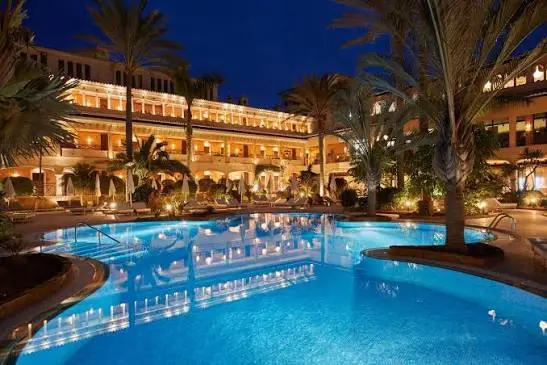 Beachfront Luxury
The island's most complete adults-only resort: 242 suites in Moorish- and Andalusian-inspired buildings on the beach at Corralejo, with seven restaurants, a full spa and the Corralejo dunes and Lobos Island ferry close by.
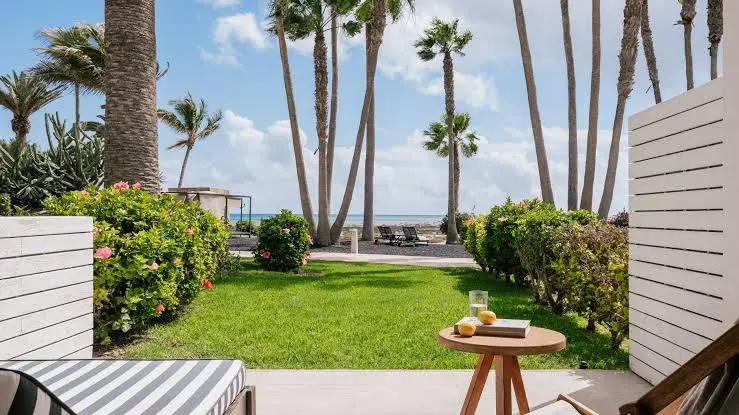 Watersports & Wellness
Directly on the famous Sotavento beach, this adults-only hotel is built for active couples: an on-site windsurfing and kitesurfing school, yoga and Pilates classes and a 24-hour gym, with the lagoon and dunes of Jandía right outside.
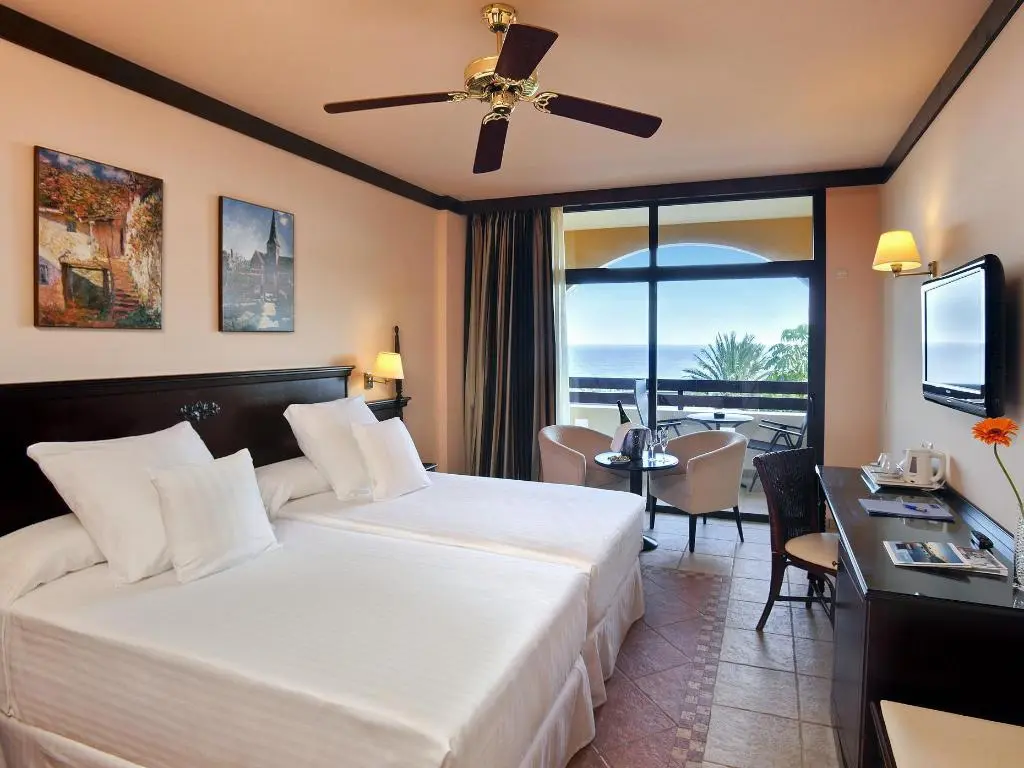 Royal Level
An intimate 64-room adults-only Royal Level with Balinese beds, a private pool and access to five restaurants across its sister hotels, just 400 metres from the long white sands of Jandía beach at the island's southern tip.
Plan Your Trip
Fuerteventura Airport (FUE) sits on the east coast, 10–15 minutes from Caleta de Fuste, around 35 minutes from Corralejo and about 65–70 minutes from Jandía and Morro Jable. Compare fares from your city below.
Curated Experiences
Three experiences built around the things that make Fuerteventura singular — its ocean, its dunes and the wild peninsula at its southern edge.

A luxury catamaran departs from Corralejo harbour and traces the coastline of the dunes reserve from the sea — the only way to truly appreciate their scale and colour — before crossing to Isla de Lobos, the uninhabited nature reserve just two kilometres offshore. You swim in the marine reserve, snorkel over volcanic reef and spend an hour on a beach that sees fewer than 300 visitors a day. Lunch and open bar included on board.
Check Prices on Expedia
Isla de Lobos is technically a separate island — a volcanic islet of pristine black coast, salt flats and marine reserve water — yet almost nobody visits it. A short ferry crossing from Corralejo delivers you to a hiking trail that circles the island in under two hours, passing a Roman-era salt lagoon, a lighthouse and a tiny beach of volcanic gravel where the underwater visibility is typically 25–30 metres. A marine guide accompanies the snorkel section and identifies the species specific to this protected zone.
Check Prices on Expedia
The spine of the Jandía massif — its western faces, hidden beaches and the barrancos carved by ancient volcanic activity — is accessible only by four-wheel drive. This full-day jeep safari enters the natural park via tracks closed to standard vehicles, reaching viewpoints, clifftop coves and the extraordinary Playa de Cofete: a twelve-kilometre wild beach backed by 800-metre peaks with no road access except through the mountains. Lunch, guide and all equipment provided.
Check Prices on ExpediaPlan Your Trip
Travel Tips